Showing posts with label Bibliography Assignment. Show all posts

Wednesday, 13 April 2011

More Electronic Sources: Everyday Exile

Okay, so I hit the jackpot.  After following a blog trail, one of the comments on a Overlooking Tibet post was from a Non-Profit in Mcleod Ganj.  Everyday Exile was founded in 2010 and is platform that allows Tibetans in exile anywhere in the world to share their personal stories, in words and in images, with an online readership.  Could I possibly find a more perfect blog to stumble upon?  My whole project is about collecting these stories!

Everyday Exile was founded by Tammy, who came to Mcleod Ganj in 2009 volunteering as an English conversation teacher, helping to plan events to broaden awareness of the Tibetan situation.  The person stories moved her deeply, and upon returning to the US she was surprised by how many people were clueless about the Tibetan situation.  I have not yet been able to gather if she is still in Mcleod Ganj, but I cannot think of a better contact in the field for the field study project I am doing.

I am a little unclear if the blog is where this process is taking place, or if the blog simply works as a companion to the cause.  The great thing about these electronic sources is that I can ask!  So far, there are two parts to Everday Exile I have tapped into.  The main blog, which provides news updates and local happenings, and a Photojournalism blog.  Being both a creative writer and a photographer, I could not be more excited.  The photographs really do have a way of telling a story, and it is my hope to take similar pictures as a companion to the creative project I am developing.

I cannot wait to connect with this organization.  Suddenly accessing the community and tapping into these stories does not feel near as daunting as it did a week ago.

Electronic Source: Overlooking Tibet

After browsing some of the blogs Kangpa follows from his blog about his experiences in Dharamsala, I found another blog I am interested in following.  It is called "Overlooking Tibet: Ways outsiders dismiss and disempower Tibet and Tibetans...from outsiders trying not to."  With a title like that, I was very curious to see what this blog had to say.

I cannot find any information about the author, but form his blog posts I can gather bits and pieces.  The author has been to Tibet several times, even during politically sensitive periods, and speaks Tibetan.  Based on my less than perfect experience learning Tibet myself, I think that is great.

This seems to be a fairly new blog and is not posted on very regularly, but the things that are posted are very useful.  One article, "Restless Endangerment," in particular I thought was useful as a new field facilitator taking a group of seven other students to India for the first time.  Of course, it is not Tibet, but I think some of the basic safety precautions mentioned here can be very applicable.

The authors advice?  Register with your countries embassy (going to do that, Ashley said that I register with Delhi), and also to not distribute anything widely  or not put yourself in the middle of a crowd.

I did not really understand the first safety tip, but the author explains that a lot of people want to distribute pictures of His Holiness the Dalai Lama to the people in Tibet, but in large groups of Tibetans there is usually at least one spy among them.  It would be a bad move for a tourist to facilitate this by distributing these images inside of Tibet.  I have never even heard of this being a problem, but this is really serious.  The author ends the article saying that "as a tourist, we can go home after your few weeks in Tibet are up.  After we are no longer watching, how many people will go to jail?"

Another great thing about this blog is that the most recent comments are posted along the side (I have not yet seen that feature, and am considering putting it into my own blog), and there are other links to follow.  The chase for more great electronic sources never ends!  I am excited to be a new follower to this blog.  Though the posts might be few and far between, they are interesting and and well thought out.  I think a lot of what the author talks about with cultural sensitivity goes hand in hand with field study goals. 

Wednesday, 6 April 2011

Electronic Source: The Tibetan Plateau Blog

In searching for good electronic sources, I found a great blog, The Tibetan Plateau, that keeps on recent news and events going on in Tibet.  From what I have gathered, it is a hub for all kinds of interesting topics that people can look further into with helpful links and videos.  I know that we often struggled to find sources to read in the prep class on current issues, and this looks like a great place to start.

So far, this source has taught me that the nomad culture of Tibet is vanishing, there are a lot of environmental issues going on with China wanting to mine, etc. that is being monitored by Google Earth, and some of the responses of India to Chinese particular Chinese officials.

More than anything, this blog is very informational.  The labels show that there are two authors posting, but no other links or labels are given.  There is, however, a search box, which is nice.  It has a lot of helpful links to other blog posts, news reports, and academic sources that give the reader the choice to follow up on.  There are 113 people following this blog, and it can be translated in 11 different languages.  While it is not posted on incredibly regularly, the posting is consistent.  There is a lot to be learned from this blog, and I am excited to be the 114th follower. 


Electronic Sources: Another Dharamsala Blog!

I know that this is called a bibliography assignment, but more than anything it is supposed to be for me to find sources that will help me continue and learn about my project.  After meeting with my faculty mentor, Dr. Burton, I realized that finding electronic realms of communication was really important for my blog.

In the field, I am taking a Digital Culture course contract with Dr. Burton.  I will flesh this out later, but the three themes I need to tackle in this proposed course are how my digital media can be used to Consume, Create, and Connect.  Based on my  last field experience, my Ghana blog did a lot of consuming and creating, but I seriously lacked on the connecting part.  With this second round through, I am going to tackle that last "C."

So for one of this weeks sources, I found a block called "My Thoughts and Activities in Dharamsala."  It is a blog by Kangpa Tasapo.  He was born in Brooklyn, grew up partially in Panama, and lived in Florida after middle school.  My favorite part?  He dropped out of high school to live on the streets and hitchhiked around the US.  Eventually he ended up in Berea as a transient and went to Berea College, got a B.A. in Asian studies, and is now living in Dharamsala studying Buddhist Philosophy at Sarah College for Higher Tibetan Studies.  I love biographies like this.  Hitchhiking across the country was always a bit of a dream for me.  I only ended up doing it seriously when I lived in Hawaii though.  Anyways, I think we would be good friends, or at least have good conversations.

He blogs very regularly, and his posts are thoughtful and well done.  He refers to books he has read, things he is studying, and is an entertaining writer.  I wish that he had labels somewhere so that I could navigate through his experience though.  At the moment it seems a little daunting.  I am excited to follow his blog learn about some of the things he has experienced and get a little more acquainted with the place I will be living in for three months. 

So yes, this source assignment was technically in the realm of "Consume," but I think it is great that it also has the potential to get me connected.  Another great thing about Kangpa's blog is that he has a lot of followers and also follows other blogs that will link me to similar people interested in things that I am also interested in!  I am really excited to follow this blog.

Wednesday, 30 March 2011

The Tibetan Book of the Dead

Of all my preparations for India, this book was one of the most enjoyable.  Not necessarily because it is full of the easiest concepts to grasp, but because my particular addition is full of gorgeous pictures and illustrations.

You could see how this could be more enjoyable, but also insightful.  This was the first time I realized just how different Tantric, or Tibetan Buddhism, was going to be compared to all the other forms that I had learned about and experienced.  The images are very bright, and many times they are not the happiest sorts of pictures.  There are many demons, blood thirsty villains, bodies half devoured, pictures of a hell kind of depiction, and the list goes on.  In many ways it reminds me of some of the Hindu art I have seen.  The book explains that the reason they are so terrifying is so that people remember that they have to be on their guard and protect themselves from falling off the path by negative influence.

Other things I learned from the book were that the Tibetan Book of the Dead is very similar to the Egyptian Book of the Dead.  There is an almost undeniable relationship between the two, which I think is very interesting to consider.  In many ways, it looks as though Tibetans are obsessed with death, but I think a better way to look at it is to see that they are actually really obsessed with life and getting out of the cycle of reincarnation. 

It is not a thin book, but it is these doctrines that I would like to do more exploration on.  I wonder how these original Tibetan religious influences impacted their present day Buddhism and what that process looked like. 

Hillis, Gregory.  The Tibetan Book of the Dead.  New York: Metro Books, 2008.  Print.

Daily Advice From the Heart- 365 by the Dalai Lama

Sometimes I freak out that I have to get two sources a week for our preparation class, but as of right now I am actually really excited about it.  I've finally come to realize that finding sources does not necessarily mean that I need to find something that has everything to do with the exact topic I am studying.  In fact, it can be about the location I am going to, the religion of the people, and a world more.

This little book, Daily Advice From the Heart, is one of those kind of sources.  I've had it for awhile, but I have never had the time to look through it too intensely. It is stocked full of quotes for just about every stage and phase of life. Every time I pick up this book I find myself surprised.  I think it is easy to say that all religions have certain fragments of truth and and a similar core in the right spirit, but I think it is also important to recognize that there really are differences that cannot be missed.  For me, this is how I realized what the 8 Fold Path means as far as where attachment is concerned.  There is still a lot with this doctrine I do not completely understand.  I know that it is something I will definitely look into when I get to Dharamsala and get to know their beliefs on a more personal level.

Just an observation, the advice is very practical.  His Holiness seems to give advice that anyone can apply to their lives.  It is not wrapped up in theoretical mumbojumbo.  In many ways it is like a step by step guide through living the happiest life possible.

I've decided that I want to incorporate this into my scripture study each night.  Not replace it or anything, but just get into that mind set.  It is meant to be read daily, so why would I not do just that?

Lama, Dalai XIV.  Daily Advice from the Heart.  New York: Metro Books,  2003.  Print. 

Wednesday, 23 March 2011

Life in Exile in Dharamsala: by Shiho Fukada and Ed Wrong

Thanks to my friend, Jay, I found one of the coolest sources yet!  It is called the Life in Exile in Dharamsala, and it is a blog put together by a guy named Ed Wrong (text) and a photojournalist, Shiho Fukada, from the New York Times.

I find this source very refreshing.  I often feel like the photographic component of my project is left in the dust while I am always scrambling to find sources on writing or information about the location I am going to.  Here I get images.  Good pictures.  The kinds of images that I might be able to experience and also photograph (if I am lucky). 

For example, I can tell that this photographer did not use any artificial lighting.  It is all natural, which is what I use to photograph.  I guess it is nice to see that you can get good images even if you are not taking in the best and fanciest equipment in to the field.  I always knew that, but it is nice to have it validated. 

I am also noticing that a lot of the images are with people and places on the street (which turned out awesome!), but there are several with the Dalai Lama.  More than several.  I wonder how he was able to gain access to the point where he could photograph him.  That is the best part though-since it is a blog, I can ask!  It is immediate, and I have a good chance of having a discussion with him where I might not have otherwise. 

This source was encouraging.  I struggled a lot with photography when I was in Ghana last summer, but I based on the lessons I learned the hard way there I was hoping to do a better job of it in Dharamsala this summer. 

Dukada, Shiho.  "Life in Exile in Dharmsala" Photoshelter. 11 Mar. 2010. Web. 23 Mar. 2011.

The Art of the Personal Essay: by Phillip Lopate

This book was recommended to me by my mentor, Dr. Burton.  Still frustrated that I have not been successful in finding someone in the English department willing to oversee my creative nonfiction course contract, this was a nice source to look through to get myself geared up for it.

What I like about this book is that it has 75 of examples of the personal essay and how it has evolved through time.  I was pleased to see that Walter Benjamin, someone I have been extremely fascinated with for my previous project in Ghana, had a few essays himself in it.  Another great feature is that it contains essays from both the East and the West, which is always good for someone looking at going to India of all places.

I think that this will be most directly beneficial for me not necessarily because of the content, but because of the form.  From my travel writing class I took in the field last year, I learned a lot about using other authors forms and attempting learning exercises and imitations off of those forms.  My mentor described it is as trying on different clothes.  Some will look absolutely ridiculous, some you would never in a million years try on, but it is fun to just try it.  You never know, sometimes you are pleasantly surprised by what you find.  I know that through those writing models I was able to learn much more about my own style.  I definitely integrated some other elements into my writing that I had not before. 

The moral of the story is that I think this is one of those books.  I do not have to agree with all the essays.  I do not have to just merely enjoy them.  I can learn from them and apply them to my own essay writing.  Now I just need to find someone to oversee that contract in literary nonfiction... Any ideas?


Lopate, Phillip.  The Art of the Personal Essay: An Anthology from the Classical Era to the Present.  New York: Anchor Books, 1994. Print.

Tuesday, 15 March 2011

10 Questions for the Dalai Lama

Over the weekend I had the opportunity to watch a documentary called 10 Questions for the Dalai Lama with my roommate Maggie.  It was really informational, and great for expanding some of the things I am including in my bibliography!  There was a lot in there about Dharamsala, the location I will be going to in just three short months, and more history about the path to exile the Tibetans faced.

In general I enjoyed the material, especially learning more about the personality of His Holiness.  He is really modern, and the film mentioned that when a debate between science and belief come up, he usually sides with science.  He is also not the biggest fan of big parties and festive holidays, which are abundant in Tibetan culture (especially when they are for himself!)  You see him in the video fidgeting with something near him or laughing out loud, and it is just so endearing.  He is a real person, and to be honest he sounds and seems a lot like my idea of Yoda.  I am not sure that is very culturally sensitive....

One thing that I did not like about the documentary was some of the commentary of Rick Ray.  I could not help but wish this guy took the prep course, or some kind of course, to try and break away from his American paradigm.  I feel like the whole time he is trying to fight it by saying "America is bad for not doing this or that" but then he makes sweeping accusations like a smile = being happy, poor people in India are happier than the rich, etc.

I did, however, learn a lot more about the background behind the flee to India.  The Chinese invasion was a lot more brutal (according to this documentary) than I realized.  I also did not know that Google and other search engines and media were paid off by the Chinese to only pull up government approved sources about the Dalai Lama.  From an economical standpoint, Tibet has little to offer and it is a "moral decision" as the Dalai Lama told US congress, but money talks.  I also did not know that the next Dalai Lama was chosen, then captured by the Chinese as the youngest political prisoner in the world (hasn't been seen since), and that the Chinese instituted their own in an effort to control the Tibetans by hand selecting the next leader.  This is why the position of the Dalai Lama very well may end with the 14th.  Yet, I do not know how the people and culture can survive without that leadership role.  Hard situations...

This documentary did give me something else I did not anticipate- hope that maybe I could request an appearance with the H.H with my group.  It is a stretch, but if I email in advance like this guy did and explain that we are students really interested in this culture, maybe we could be granted the request.  If I had two minutes with him, what would I ask him?  How would I show him that I really was interested?  What would it feel like?  Anyways, it is worth a shot!

How to be a Mormon Abroad...

I cannot say enough about this blog post, so I am going to let Nephi Henry, the author of it, say it for me.  It might not be a conventional source for a bibliography, but for my personal needs I think it is really rich.  I am just copying and pasting his insights about religion in India.  I found it very helpful for some of my own concerns and big questions.

"My crisis this summer: Is my God in India? Was my idea of God an exclusive, ethnocentric view, blind to whatever truths might be around me just because I wasn't in a place where my American God wasn't immediately available? In a lot of ways, the answer to that question was yes: I couldn't find much of anything in India that I could easily call God. I had learned to call God a Being I could contact and get in touch with when I was alone with my thoughts, in a quiet or remote place. In India that type of situation seemed impossible to find. God for me had been a Father, in some very literal sense of the word, and I was to be like Him. Nothing around me indicated that possibility at all. It had me distressed - until, that is, my final night in India. That night, almost exactly a month ago as I write this now, I came to understand that God understands and appreciates cultures, and reveals truth within cultural contexts to allow humans to live moral, beautiful lives full of light.

Wednesday, 9 March 2011

Tibetan Folk Talkes: by Frederick and Aubry Hyde-Chambers

Jack POT!  I have discovered an anthology of Tibetan folktales!  I am so excited!

This work is taken from the ancient oral tradition and is packed with imagination, color, and wisdom-filled stories that are for all people of all ages.  It includes the Tibetan creation myth (which would be really interesting to read all the way through), and also some of the famous Jataka tales and stories form the former lives of the Buddha.  Of course, the most popular being the one most closely associated with Tibet, the great epic of King Gesar of Ling, "the warrior who became a national hero."  I have only had time to skim so far, but I can tell it is going to be a great read.

It might not seem directly applicable to the literature I have been collecting, but if stories do make up our identity (the stories we tell ourselves about ourselves), then wouldn't these traditional tales be rather revealing about the Tibetan people, at least in some degree?  I tend to believe so.

 This discovery got me thinking about my own project and my own paradigm of cautionary tales, etc.  The Brothers Grimm for example.  When I went rock climbing with a friend last week she was telling me that these brothers got their stories from traveling all over the world and documenting their stories.  I have got to look more into this, because I feel like I am attempting this in some degree (except no the world, and not necessarily mythical stories, but rather the lived experience).  Anyways, I think I found my next source for next week. :)

Tuesday, 8 March 2011

Hamlet: By William Shakespeare

I never would have guessed that Hamlet would be something I would throw into my sources, but lo and behold I found a great quote that could be a great argument, or at least a hook for a literature review in my project proposal.  It currently sits in my IRB second draft, but I know they do not like the cute-y stuff, so we'll see if it there for the final draft. 

This quote comes in during the final scene where Hamlet is on the verge of death.  Horatio is really upset and threatens to take his own life when Hamlet says:


"If thou didst ever hold me in thy heart,
Absent thee from felicity awhile,
And in this harsh world draw thy breath in pain
To tell my story"

I guess it really just got me that this was one of his top concerns when he was on his death bed.  It had nothing to do with his unfinished business or messages to people (if there were any people he knew left by the end), but I think Hamlet knew the importance of stories.  This took me on a great stream of thought.  Why do we love stories so much as children?  Why did Jesus preach in parables?  Why are the gospels written by four different people on the same topic, but yet reveal very different perspectives?  There is some value to this.  Some method to the madness if you will.

Isn't it great!?  Hamlet always seems to have an answer to everything.

Shakespeare, William.  Hamlet.  New York: Bantam Books, 1980.  Print.

Tuesday, 1 March 2011

Tales of a Dalai Lama and Tales of Uncle Tompa

I found a few different sources I want to look more into that are off the beaten trail.  Still looking for more evidence that the Dalai Lama encourages incoming refugees to tell their stories to the world, I came across two interesting books.  Tales of a Dalai Lama and Tales of Uncle Tompa.  Both are fictional, but could give me some great insights about the use of story in a Tibetan setting.

The first, Tales of a Dalai Lama is pretty didactic and is packed with cautionary tales.  It is supposed to be more religious and philosophical in nature, and in the beginning the author admits to not knowing much about Tibetan Buddhism.  This book also references some other religious texts like it to look into, like Mulla Nasrudin, the jataka tales, rabbinical midrashim etc.  Until now I did not even know that these existed.  This could make for some great reading before and during my field experience.  I am sure there is a lot to learn.

The Tales of Uncle Tompa, however, are supposed to be really funny.  It is less focused on the spiritual and more on a unique Tibetan humor.  All things regarding my project put aside, I think that humor is one of the hardest things to grasp when doing cross cultural interaction.  Reading this book could really get me a head start on that.

Apparently Uncle Tompa is a humorous collection of folktales about a rogue who is somehow spiritual despite being a little rough.  It is supposed to capitulate the everyday lives of Tibetans, which intrigues me more than many of the other sources I have come across.  Plus, it has pictures!  Can you really beat that?

Again, some more sources I want to look more into not just for their value in a literature review, but just for entertainment sake and better understanding the population I will be living with in just two short months time!

Delattre, Pierre.  Tales of a Dalai Lama:  Standpoint:  Lost Horse Press, 1999.  Print.

Dorje, Rinjing.  Tales of Uncle Tompa:  New York:  Barrytown Limited, 1997.  Print.

The Art of Happiness: A Handbook for living by the Dalai Lama

I landed on another great source!  I finally found a book that I can cite that talks about the Dalai Lama encouraging people to tell stories.  In fact, he is the one who wrote it!

The Art of Happiness: A Handbook for Living is by the 14th Dalai Lama.  It is made for all audiences, no matter where they are at in their personal journey.  He says that "Whether one believes in religion or not, whether one believes in this religion or that religion, the very purpose of our life is happiness, the very motion of our life is towards happiness." 

As a winner of the Nobel Peace Prize, His Holiness uses this book to talk about the things that bring inner peace and the keys to building a happy life.  This book is interesting though because it combines Buddhist philosophy with a Western psychiatrist (Cutler).  


One of the most important things I can gather from this book is that through meditations, stories, and the meeting of Buddhism and psychology, we can learn to defeat day-to-day depression, anxiety, anger, jealousy, or just an ordinary bad mood. In this book we have discussion on relationships, health, family, work, etc to show us how to get over the mundane and make life meaningful. 

Not only is this going to be a good source as far as finding the answer to the great question of where encouragement for telling stories is quoted, but I also think it is straight up interesting.  I am really fascinated with depression, and I think a Buddhist take on it will be an interesting read.  It is definitely going on my "to read" shelf on goodreads.com.  Hopefully I can add it to one of my course contracts and read it in the field as well.

Lama, Dalai.  The Art of Happiness: A Handbook for Living:  New York: Riverhead Books, 1998.  Print.

Tuesday, 22 February 2011

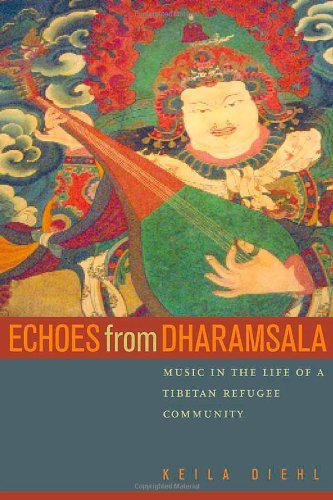
Echoes from Dharamsala: by Keila Diehl

I am beginning to give up on ever finding a direct quote from the Dalai Lama on telling stories.  Emily said that she heard it a lot from their personal accounts, so maybe I can just site her experience?  I have been looking for hours to no avail!  It is kind of frustrating...However, through the search process I have found yet another interesting article for my bibliography.

Echoes from Dharamsala was another source recommended to me by Emily.  This is about an ethnographer who is looking particularly at music in this refugee settlement, and she lists several reasons for doing so.  The thing that struck me the most was how beautiful her writing was.  I really loved her style!  She says that he writes with a "personal-professional nature" (xxiii), and that having the two voices change is advantageous fro what he is doing.  It reminded me of my own project and the concept of layers within a single travelers voice that adds that level of authenticity.

There is a lot to be learned from this book, and it is one I would like to read all the way through.  Another thing I enjoyed was hearing her reluctance for studying at Dharamsala instead of one of the many other settlements.  Like her, I too was reluctant when I first heard that Dharamsala was a touristy place.  I am kind of a village girl- preferably one that is not on Google maps.  Yet, she is just engulfed with the place, which is something I anticipate as well. 

This source will be good to explore for the narrative quality and for the creative components  she looks as.  She also seems to dive into preserving cultural identity, which will be something I encounter as well.

We also get pictures in this one!  So refreshing! It's nice to look around and see I am not alone.

Diehl, Keila.  Echoes from Dharamsala: Music in the Life of a Tibetan Refugee Community: Berkeley: University of California Press, 2002.  Print.

Freedom in Exile: The Autobiography of the Dalai Lama

Emily Bell suggested I read Freedom in Exile: The Autobiography of the Dalai Lama to find out more about what the Dalai Lama says about stories.  After a pretty intense skim, I was unable to find a direct quote on the importance of telling stories, but I think in many ways it is implied, and here are some of my observations.

The Dalai Lama opens by saying that he is writing this book in English despite his limitations with the language.  I think this also reflects the importance of an English education that the children are getting as refugees in India, which says something about writing in a way so that you can communicate to the world at large.  I ran into this argument a lot last year when I was looking at post-colonial writers in Africa

We also get a glimpse of his love for stories as a child.  It was always something he looked forward to, and he had quite a vivid imagination (28).

Also, we have this story in general to take into account.  His Holiness says that he wrote it so that people would understand why the Dalai Lama is an "ocean of wisdom" and educate people about the history with Tibet (1).

Something else I am excited to look more into are the little details that the Dalai Lama writes about his life.  Bits of his personality, his childhood, and the personal narrative of his exile.  There are also some great pictures included in my version, which always makes the photographer part of me smile. 

This is definitely something I want to get more into.  However, I am still looking for a single quote or some kind of evidence for the Dalai Lama encouraging people to tell stories.  I know it is out there somewhere!

Gyatso, Tenzin.  Freedom in Exile: The Autobiography of the Dalai Lama: New York: Harper Perennial, 1991.  Print.

Tuesday, 15 February 2011

Method Meets Art by Patricia Leavy

My friend and coworker Jay recommended that I read the first chapter of this book, Method Meets Art: Arts-Based Research Practice, and I am really grateful he did.  I wanted to underline almost everything as I went through this chapter, and I am sure that as I look more in-depth at the chapters on narrative inquiry, poetry, and visual representation I will have much more to add.

I feel like I have been looking for this book ever since I started field studies.  I am one of those "others for whom these research conventions make what was once a passion start to feel more like a job" (1).  This is why I have always turned towards more artistic approaches, and my whole avatar framework I developed in Ghana would certainly fall under this.  I loved this article because it articulated what I have been internally screaming for years.  Here are some of the insights I gathered.

By doing arts-based "research," we can "bridge and not divide both the artistic-self and the researcher-self."  There is a "profound relationship between the arts and sciences," and there are several viable reasons that more and more people are turning towards alternative methods (2).  Art-based research is more holistic, it is a new genre that "comprises new theoretical and epistemological groundings that are expanding the qualitative paradigm" (3).  In many ways it can capture and represent what traditional research cannot, some of the most fundamental aspects of human experience.  Additionally, there are "tremendous meaning-making and pedagogical capabilities" within this emerging genre.  It is not merely used at the representation stage of research, but during all phases instead (4).

This chapter also talked about the qualitative paradigm and how it has changed based on the emergence of ethnography with people like Geertz and Goffman coming into the picture.  Starting int he 90's though, art-based practices became a legit new method.  The cool thing I find about this is that it looks at "knowledge as a process, a temporary state" (9)and that it is not linear.  Rather, it is iterative, and meaning emerges through "labeling, identifying, and classifying emerging concepts and testing hypotheses; finding patterns; and generating theory" It helps us to look more at the process of meaning-making as well (10).

Sunday, 13 February 2011

The Seven Basic Plots: Why We Tell Stories by Christophor Booker

This book stood out to me because it sounded a lot like the sources Emily was quoting when talking about a universal narrative, and how it is so quintessentially human.  This book has been cited almost 500 times, which tells me it is a very credible source to look into.

It begins by relating the movie Jaws to Beowulf (the overcoming the monster plot), and how there are so many similarities between the basic story lines in all places.  At first the author says that he was not so sold on this notion, but after 30 years of research he is ready to buy into it.  I have not read the whole book (it is a BIG book), but the 7 plots he goes into are overcoming the monster, rags to rights, the quest, voyage and return, comedy, tragedy, and rebirth.  Booker says that it does not take us long after we start talking to begin demanding stories, which is evidence of the innate appetite we have for them.  However, this source goes beyond noticing the phenomenon, but tries to identify why we do it.  Booker goes on to say that if you say random words you are given mental images, and these go on to create sequences, and like a film we see this manifested in things like dreams.  As humans, we have remarkable imaginations and it seems we cannot refrain from crafting stories of our existence. 

Booker then goes into a bunch of different books and movies and talks about some of the basic plots that connect them all, but what was more interesting to me was what he says about why these stories are found in all different cultural contexts.  I think that this could be a great source to tie together some of the thoughts I am having about the universal narrative, and it answers some of the fundamental questions about why we tell stories to begin with.  For a creative project, it is necessary to have a source like this to justify me going into the field at all. 

Booker, Christopher.  Seven Basic Plots: Why We Tell Stories.  New York: Continuum, 2006.  Print.

Wednesday, 9 February 2011

Interview with Margaret Atwood

In order to keep to my plan on researching narrative theory this week, I looked specifically at the art of storytelling and what is so human about it.  I always enjoy finding insights from good authors when it comes to research.  This one was an interview with Margaret Atwood on the topic of "Why Do We Tell Stories?"  This is what I got from it.

 She says that the reason why we need to tell stories as part of the human condition is because "language is one of the most primary facts of our existence."  It is what sets us apart from other animals.  She shares another theory that narrative art has evolved adaptation because if you hear a story about what not to do, you won't do it.  To demonstrate this point she uses an example of a river with a crocodile.  She says that "if I can tell you that right over there in that river was where the crocodile ate Uncle George, you do not have to test that in your own life by going over there and getting eaten by the crocodile."  I think that is a pretty interesting theory, it would make sense in the light of cautionary tells that seem to be in all cultures because "we know that people learn and assimilate information much more through stories than they do through charts and graphs."  Especially when there is so much emotion, which is so fundamentally human.

We are not just "thought" or "screaming" entities, we are "thought/feeling"beings.  This is what her thoughts are on why storytelling is so universal and why we need to tell them.

Why We Tell Stories.  Big Think.  Creative Commons, 21 Sept. 2010. Web. 8 Feb. 2011. <http://bigthink.com/ideas/24259>

Narrative Inquiry: Experience and Story in Qualitative Reseach by Clandinin and Connelly

I am more and more intrigued by how much is out there on storytelling in academia.  There are a lot of ways to approach stories, and this book was highly cited as one of the most useful to help me better understand narrative inquiry.

This book takes the approach of storytelling as a qualitative research method.  Commentaries on this book are along the lines of it being clarity when there were so many theoretical gaps before.  It seems to be really fluid and gives a lot of examples, which helps me a lot.  This book looks at the journey of these two scholars,D. Jean Clandinin and F. Michael Connelly, who have studied narrative inquiry for the past two decades.  They look at how narrative deepens our understanding of an educational experience.  These encounters then seem to be a model for intellectual courage within the individual.

This could be really useful for a few reasons, but one of those being that it has a whole chapter dedicated to Clifford Geertz and his theories.  Since Geertz is one of my main sources for my project, this is right down that alley.  It also has a whole section dedicated to encountering stories in the field that I can benefit from.

For me, I am still not so sure if this is directly applicable to what I will be doing collecting stories in Dharamsala, India.  Yet, I am glad that there is some literature out there that can support my academic claims when it comes time to do the IRB application and apply for scholarships.  I am overwhelmed by how much is out there on why we tell stories. Now it is just about finding the right sources... I think that this one would be very useful if I look specifically at Tibetans and why they tell stories, but as far as fitting it into the rest of the population there, I am not so sure the cookie cutter fits.

Clandinin, Jean.D, and Michael F. Connelly.  Narrative Inquiry: Experience and Story in Qualitative Research.  San Francisco:  Jossey-Bass, 2004.  Print.