Wednesday, 23 February 2011

February 23, 2011: Time Log

120 min- Watching the movie 7 Years in Tibet

210 min- Looking for sources, skimming through the Autobiography of the Dalai Lama and Echoes from Dharamsala

80 min- Doing Methods 2 practice and write up

60 min- Writing up this time log and the journal entry for the day

60 min- Going to the travel office, trying to coordinate with Hailey if we will be going into Dharamsala together

Total- 550 minutes

February 23, 2011: Learning Journal 6

Has it really been another week already?

I guess so.  I think as far as preparing for my project goes, my favorite part was watching Seven Years in Tibet.  Since I had heard it was pretty Hollywood-ish, I was not prepared for much, but I was happily surprised.  I learned a few things about Tibet and Tibetans that I was not familiar with before.  One thing that stuck out was that they clap to warn off an evil presence, and stick their tongue out as a more favorable greeting.  I do not quite remember, but I think I once read that it is a way of showing respecting, but in the movie it seemed like a way of saying hello.  Something to look more into.

From the movie I also was introduced to butter tea.  Gay Lag, or TJ La my Tibetan teacher, told us that this is a very common drink.  I have talked to my roommate and she is down with us trying to make it so that I can try to get used to it.  I liked the end of the movie where the cup of tea is left for the person waiting to return.  I too hope I get a white scarf.  :)

But back on the subject of tea, there was something in our class discussion last week that made me realize that this is going to be a tricky subject.  Being a Latter-day Saint, we are not supposed to drink tea, but I know that there are different kinds of tea that are kosher.  I've never had tea around, so I have no idea what those are, or if I like any tea at all, but this will be a sticky situation in Dharamsala.  When talking about ethics, Jay asked us to think about what we will do when offered tea.  My immediate response was that I would say it is against my religion.  However, Breanne was in the class, and she let us know that it needs to be a personal responsibility thing because several students in the past have had the tea, so that excuse will not work.  I jokingly thought about saying that I was allergic (but I had better watch out, because I just found out that I really am allergic to fish, where I used to apply this excuse universally).  That probably will not fly either though.

The more I think about it, the more I am convinced that I just need to figure out what kind of tea is kosher and try to get used to it before I go.  Luckily I have awesome roommates who will support me in that.  However, I do run the risk of coming off rude or demanding, but if I approach it right I think it would be better than outright refusing it.  With people I am intimate with, like my host family, I will explain the situation, but for just doing down the street I have to have some idea of what I am going to do.  It reminds me of the book Three Cups of Tea.  Granted that is in Pakistan, but the whole idea behind it is that the first cup, you are a stranger, the second a friend, and by the third you are considered family.  No, it is not the exact same culture, but it is clearly more than just a cup of tea.

Methods practice 2 was also a good lesson for me.  It was helpful to see what it is going to take in order to pull of a more creative project.  It is something I am excited for, but it will be tricky to pull of the balance I need between personal experience and objectivity in what I do not understand.

As far as other reading, I am excited about the new sources I found.  Freedom in Exile: The Autobiography of the Dalai Lama I think will be a particularly fun and useful read.  It is something I want to put into my course contract this summer.  Hopeful a directed readings with Professor Aaron Eastley.  I am still on a mad search for a source that sites the Dalai Lama encouraging Tibetans to share their story with the world as Emily suggested.  I guess I will try again next week.

Methods Practice 2: Participant Observation and Jots

Now that I know what it is I am looking for in my project, I can now try and generate a method on participate observation that would be the most useful for my personal needs.  For this reason, I chose to look at youtube videos on Dharamsala to get practice observing the foreign place.  However, because I am doing a more creative project, I need to have jots that are more aesthetic in nature.  There is an interesting balance I try to capture here.  They try to be subjective only when I can pull in previous life experiences and observations.  I try to be objective when I am defining something I see.  Having a writers approach to my jots, however, will make it easier to expand these into something someone would actually want to read.


What I have documented here are expanded jots.  I would to go one step farther to generate what it is that I need for my project. I watched two videos, which I link below, and was watched them each twice.

Video 1
 I turned off the sound.  There was background music with a woman singing in a language I do not understand. 

It then starts with landscape shots, the green is a brownish green.  This is where the writer comes out.  I have a theory about different greens, and why the green is different from my experience in Hawaii, Ghana, etc.  This is subjective, but something I could add to make more interesting.

There is a stone structure, short, and hidden in the shadows with a red flag waving next to it.  They are facing away from the viewer.

The houses seem to be stacked on top of each other.  Between the streets there are prayer flags waving in the wind of all different colors.  Like a celebration banner we would see here (subjective, but writer jots)

Here I see a woman, who at first I thought was a man from the distance, with a braid down her back.  As she walks down the street she hits these round red decorations so that they are all spinning by the time she ducks into the alley.

There is a shot of telephone wires.  They are a tangled mess.  It is near a house.  The streets are narrow.

Monkeys are shown, and another backdrop shot.  Zooms in on the mountain, the snow blends into the clouds as if this really were the roof of the world, and there was just a leap before you touched heaven.

Tuesday, 22 February 2011

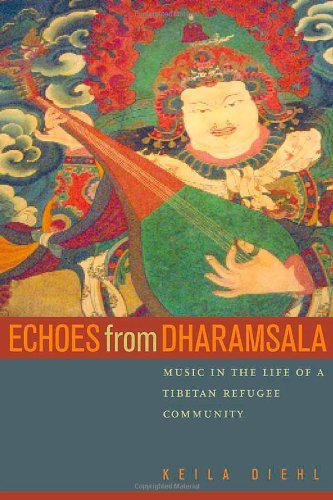
Echoes from Dharamsala: by Keila Diehl

I am beginning to give up on ever finding a direct quote from the Dalai Lama on telling stories.  Emily said that she heard it a lot from their personal accounts, so maybe I can just site her experience?  I have been looking for hours to no avail!  It is kind of frustrating...However, through the search process I have found yet another interesting article for my bibliography.

Echoes from Dharamsala was another source recommended to me by Emily.  This is about an ethnographer who is looking particularly at music in this refugee settlement, and she lists several reasons for doing so.  The thing that struck me the most was how beautiful her writing was.  I really loved her style!  She says that he writes with a "personal-professional nature" (xxiii), and that having the two voices change is advantageous fro what he is doing.  It reminded me of my own project and the concept of layers within a single travelers voice that adds that level of authenticity.

There is a lot to be learned from this book, and it is one I would like to read all the way through.  Another thing I enjoyed was hearing her reluctance for studying at Dharamsala instead of one of the many other settlements.  Like her, I too was reluctant when I first heard that Dharamsala was a touristy place.  I am kind of a village girl- preferably one that is not on Google maps.  Yet, she is just engulfed with the place, which is something I anticipate as well. 

This source will be good to explore for the narrative quality and for the creative components  she looks as.  She also seems to dive into preserving cultural identity, which will be something I encounter as well.

We also get pictures in this one!  So refreshing! It's nice to look around and see I am not alone.

Diehl, Keila.  Echoes from Dharamsala: Music in the Life of a Tibetan Refugee Community: Berkeley: University of California Press, 2002.  Print.

Freedom in Exile: The Autobiography of the Dalai Lama

Emily Bell suggested I read Freedom in Exile: The Autobiography of the Dalai Lama to find out more about what the Dalai Lama says about stories.  After a pretty intense skim, I was unable to find a direct quote on the importance of telling stories, but I think in many ways it is implied, and here are some of my observations.

The Dalai Lama opens by saying that he is writing this book in English despite his limitations with the language.  I think this also reflects the importance of an English education that the children are getting as refugees in India, which says something about writing in a way so that you can communicate to the world at large.  I ran into this argument a lot last year when I was looking at post-colonial writers in Africa

We also get a glimpse of his love for stories as a child.  It was always something he looked forward to, and he had quite a vivid imagination (28).

Also, we have this story in general to take into account.  His Holiness says that he wrote it so that people would understand why the Dalai Lama is an "ocean of wisdom" and educate people about the history with Tibet (1).

Something else I am excited to look more into are the little details that the Dalai Lama writes about his life.  Bits of his personality, his childhood, and the personal narrative of his exile.  There are also some great pictures included in my version, which always makes the photographer part of me smile. 

This is definitely something I want to get more into.  However, I am still looking for a single quote or some kind of evidence for the Dalai Lama encouraging people to tell stories.  I know it is out there somewhere!

Gyatso, Tenzin.  Freedom in Exile: The Autobiography of the Dalai Lama: New York: Harper Perennial, 1991.  Print.

Wednesday, 16 February 2011

February 16, 2011: Time Log

90 min- Reading and writing up review of Method Meets Art

60 min- Practicing descriptive questions

50 min- Attending class for  February 9, 2011

30 min- Writing up this weeks learning journal

30 min- Brain storming 20 social situation triangles 

60 min- Looking up other sources for my bibliography assignment

120 min- Drafting the first draft of my project proposal

Total- 380 minutes

February 16, 2011: Learning Journal 5

I feel like so much has happened this week I do not even know where to begin.  I think I say that every week, but this time for real!  I think that the most interesting part of the week was putting together my project proposal draft.  It seems like it has been so long since I have dusted off the process, but I was happy that the second time around was much easier than the first time I wrote a project proposal.  I understand how everything works together now, which is helpful.  By drafting it I was also able to see where I need more work.  My methods section is taking forever to write, but I think I know what I want to say, but my literature review is a disaster.  I am having a hard time transitioning between the different sources I have found.  I may need to spend more time in the library.

I am really excited about the new sources I found though.  The book Method Meets Art by Patricia Leavy that Jay recommended was particularly useful.  It is something I have felt for the longest time but until now I had never seen any literature that could argue and articulate what it is I like to do on field studies with more artistic methods.  

Working on social situation triangles also made me realize how much I do not know about what I will be doing from a day to day basis.  In Ghana, I worked in the school and things were more structured.  Structured as in I knew where I was going each day and was not completely relying on serendipity.  This project is going to be a lot different than that.  It is exciting but also kind of scary.  Browsing through different parts of the triangles was helpful, but I think that until I get there I will not be able to really fill in the gaps.  I have no doubt that I will be able to, but it is hard to just imagine it having not been there before. 

Last class period was also really interesting.  We looked at descriptive questions and interviewing, but rather than just talk about it we acted it out.  Natalie was our informant, and the rest of us tried to ask descriptive questions.  Ashley pointed out that our techniques for asking questions were all very different and individual, but I still am not solid on what my niche is.  I think it is easier to do it in real life than in role playing somehow though.  When I have genuine interest in the subject it just comes easier.  Still, I recognize the need to practice because until you find that balance it is hard to know where to start- and I could lose some great first interviews trying to figure it out!  I practiced with my best friend Rachel.  With a project as broad as mine, (and being a pretty private person), I tried to ask questions about her life that would not make her feel uncomfortable or respond with short, uninteresting answers.  I found that some of my favorites were grand tour and mini tour questions though.  I asked her to tell me what a typical day for her looked like in high school which got me some interesting stories I did not anticipate.  Example questions were also helpful here.  I think it was Natalie, but someone in class talked about how it is easier for someone to talk about what an average person would say about a situation than to express their own opinions, so I asked Rachel how someone would probably describe the advantages and disadvantages of living as a BYU student in Provo.  She was less bashful about her opinions when it seemed less personal.  This is a new skill I want to use.